from AngryAsianMan
A reflection on Waves.
I first learned of the metaphor of 'waves' of activist leanings from feminism. While arguably Eurocentric in its articulation, I still find it a helpful metaphor when considering some of the emergent sense of identity in being Asian in Australia.
Briefly, and from wikipedia:
1st Wave feminism
focuses on de jure inequalities (or sex/gender-based inequality enshrined in law)... The first of the most important struggles was/is of that to vote (to participate as full citizens in a nation).
"Women deserve the right to vote"
2nd Wave feminism
sees a slow shift to de facto inequalities (or sex/gender-based inequality enshrined in non-state-based institutional practices, as well as in socio-cultural norms). One of the major cultural issues I see at play here is, in particular, the importance of advocating for increased participation of women in historically demarcated 'male' or 'masculine' spheres of influence (e.g. 'public' spheres, managerial/government positions, etc.)
"Equal pay for Equal work!"
"Rights, not Roses!"
"The Personal is Political!"
3rd Wave feminism
sees yet another shifting disposition, into politicising the intersectionality of gender as one of and among many factors that constitute the lived material reality of women's lives. Thus a focus on pluralism, multiculturalism, inclusivity of sexual diverse, transnational discourse, migrant women's issues (as opposed, strictly, to woman-as-citizen) etc.
Here also: the 'reclamation' (or simple 'claiming') and radical valuation of positions historically constructed/demeaned as female/feminine: e.g. Slut-walks, 'lipstick feminism,' etc.
"The Master's tools will never dismantle the Master's house" (Audre Lorde)
"Stop slut shaming!"
Once again, I recognise that this is a very broad and sweeping brushstroke. I certainly do not mean to diminish the diversity and specificity of the actual histories and herstories of feminism(s) as it/they have unfolded til the present and hereafter.
My interest here is not in feminism per se,
but about the way that feminism, as a movement (or series of movements) has been historicised into 'waves'.
(i.e. my interest is not in history, but in historiography)
Can this metaphor of waves be helpful in considering the unfolding of postcolonial/diasporic Asian-ness (within Euro-/Anglo- American/Australian-dominant spaces)?
Here is a beginning stab at what this might mean:
1st Wave Poco Asian Politik
We see first the waves of migrants from Asian countries into European/White-dominated national settings, fighting around de jure inequalities... Most simply: To be regarded as naturalised citizens. Sometimes, historically, at least in the USA, as far as I know, this has taken on the fight by some ethnic migrants (particularly those of Indian and Japanese descent, as far as I am aware) to be regarded as "White" by the state (and thus be conferred citizenship).
"Let me be a citizen!"
2nd Wave Poco Asian Politik
We see new naturalised Asian citizens struggling around de facto inequalities, particularly pertaining to profession and cultural membership. These include being seen as individuals in highly individualistic cultures, politics of representation in historically white-dominant spaces. For some Asian men (certainly for myself), this can sometimes take on a body-politik of fashioning myself as passably 'masculine,' given Eurocentric body-/and behavioural norms.
"I speak English!"
"Asian men can be muscular / hot / athletic!"
3rd Wave Poco Asian Politik
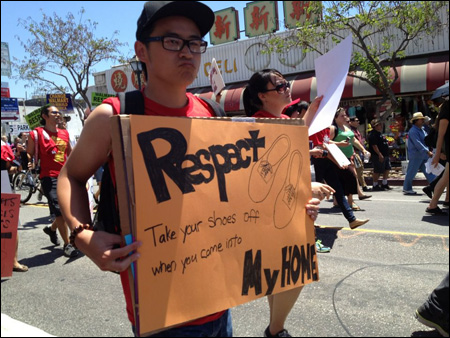
Here, the issue of intersectionality... And also about the 'reclamation' (or simple 'claiming') and radical valuation of positions historically constructed as Asian/"Asiatic," particularly by those who experience the entitlements and privileges of citizenship.
"RESPECT: Take your shoes off when you come into my home"
Let's see how this one unfolds...
Acknowledging, for now, some of my limitations in this post:
Where women have been constructed as Euro-/White-/American women
and examples of Poco Asian Politik have been male...
No explicitly queer examples ------> >:(
Wanting to expand and rectify in future posts.
Email!
musings...
If you like what you see here, or if you have anything you would like to share do send an email:
psychonauterotica@gmail.com
Showing posts with label feminism. Show all posts
Thursday, July 12, 2012
Friday, May 11, 2012
"Porn is Not a Dirty Word"
“Many men believe pornography is harmless and women should stop banging on about it...”
So begins the article, “Porn is not a dirty word,” by Bettina Arndt for The Age newspaper.
(image above is taken from the article posted on theage.com.au website)
What follows in her article is, predictably, an apology for mindless male entitlement; in this case, for the right to remain blissfully ignorant about some of the reasons that people might 'bang on' about it in the first place...
I’d like to unpack some of Arndt’s arguments one by one, and offer my response to it given my recent deconstruction of porn-as-unproblematic-product.
“Everywhere men look there’s another woman banging on about the dangers of porn.”
Not even preceded by an ‘it seems’ nor with a consideration of the many women who enjoy porn, nor also of the men who bang on about porn’s dangers as well.
According to the article, a recent Q&A program (a television program exploring current affairs and topics of general interest, often with guest speakers and audience participation) featured British sociologist Gail Dines, whom the article insinuates is one of those women ‘banging on’ about the damage done by “body-punishing, brutal, dehumanizing and debasing” pornography.
The choice of Dines’ admittedly extreme words, accurate or otherwise, is then contrasted with the level-headed voice of reason by a male audience member, Jeff Poole. Poole states on the program that he “had been watching porn for more than 30 years” and “In all those many thousands of hours of wobbling pink bits, I’ve never seen any of the things you talk about. I’ve never seen the degradation of women or men for that matter. I’ve never seen rape, real or simulated. I have never seen violence.”
According to Arndt, Poole “spoke for a huge audience of men who hear constant negative discussion of pornography and wonder why their own experiences are so very different… bewildered at women’s outrage at what they see as a harmless outlet for the strong male sex drive…” Arndt then adds, “To many men, porn seems a perfectly normal aspect of male sexuality that provides comfort and entertainment, and redresses the serious sexual imbalance between male and female desire.”
There are several problems with resting on men's perceptions of our own porn use as plainly acceptable, particularly just because it seems a "normal aspect" of our sexuality.
Simply:
1. What is normal is not necessarily good, true, healthy, or wise.
2. Arendt makes no further effort to problematise this normative assumption of the differences between male and female sexual desire, nor does she address the equally problematic assumption that porn actually SATIATES men’s presumably 'excess' desires (relative to...?).
Arndt does at least mention that there seems to be a difference in the types of stimulation that men use today compared to a generation ago, when she writes,
"While the older men in my project wrote about poring over dad's stolen Playboys, today's young men grow up with an internet sexual smorgasbord. Most report roaming far and wide, from vanilla sex to the ''oh my God'' offerings. One mentions breakfast conversations at his university college, dominated by boys sharing notes on the latest online ''girl shagged by donkey'' type video. Throughout history there has been sexual material designed to stir male loins, from Roman frescoes and Japanese screen prints to Victorian ''dirty postcards''."
However, Arendt does not seem to make a link between these generational differences and the reasons why some people might 'bang on' about the potential problems of porn use.
Porn and Desire
In her blog, Cupid's Poisoned Arrow (which she co-writes with her partner Gary Wilson), Marnia Robinson has written in a series of different different articles...
(a few, for example:
"Sexual Superabundance Part I"
"Sexual Superabundance Part II"
"Porn and Perception: Is Your Limbic Brain Distorting Your Vision?")
...that porn, far from sating our desires, is actually complicit in ratcheting them up. To defend porn because it temporarily sates our 'excess' desire is like defending the marketing of an itch cream that temporarily soothes our itch, while actually also being one of the very conditions which further entrenches and exacerbates the itching itself, making it far more difficult to ignore later.
Robinson writes, in her Sexual Superabundance - Part I essay,
"Men... have been learning to pursue orgasm even more efficiently and frequently--with a lot of help from today's media. They can also generate super-stimulating porn with a mouse click. In fact, as my husband says, 'an Internet user can see more hot babes (or whatever gets him going) in an afternoon than his ancestors saw in a lifetime.'
Are men more satisfied and happier? Are their relationships stronger? According to psychiatrist Norman Doidge, patients report increasing difficulty in being turned on by their actual sexual partners, spouses or girlfriends, though they still consider them objectively attractive. Initially porn helped them get more excited during sex but over time had the opposite effect." (information that Robinson cites from Norman Doidge's excellent book "The Brain that Changes Itself")
In an earlier post of mine, I've already covered my thoughts about the limitations of Robinson's writing, particularly in prescribing and reproducing tired heteronormative relationship types. Nonetheless, I reiterate that Robinson's strength is in helping to address the problem of Arndt's defence of porn as a harmless, sexual-excess-satin' tool for straight men...
The Sexless Marriage
Arndt writes, “The problem comes when men try to bully women into things they don't want to do - but arguably porn has nothing to do with the insensitivity causing men to behave in that way, which stems from their cultural and social backgrounds.”
Um... As if porn isn’t ALSO a part of culture and society, as if porn was not a PRODUCT of culture and society, as if porn does not also SHAPE, CHANGE and AFFECT culture and society.
It would be pretty ludicrous to assume that, for example, fast-food chain advertising in mainstream media plays NO part in influencing how we experience our desire for food, and concurrently, how we might articulate this desire when we choose to share food (or avoid food) in the company of others. So similarly, it is pretty ludicrous to assume that pornography would play NO part in influencing how we experience our desire for sex, and concurrently, how we might articulate this desire when we choose to share sex (or avoid sex) in the company of our partner(s).
Robinson’s writing is here far more sophisticated than anything I can render, in her compassionate reading of the neurochemical basis for the transition into sexlessness from what may once have been passionate liaisons. Habitual orgasm to a single stimulus (either a single woman, e.g. one’s wife, or a single image on a computer screen), diminishes the capacity for that stimulus to titillate in the same way. i.e. One requires more diversity of stimulation, or increased novelty, in order to achieve the ‘same’ orgasmic outcome.
This is not inherently a problem, of course, if one is able to understand the dynamism behind this bio-logic. However, the problem in this sexless marriage between a man and a woman requires multiple ignorances:
Two at least:
1. Of the woman, for the man’s need for variety / stimulation in order to achieve orgasmic ‘satisfaction’
2. Of the man, for the fact that this underlying dynamic is actually further reinforced, reinscribed and exacerbated through the use of porn. It is not necessarily a harmless remedy.
Arendt’s proposed remedy, one which poses itself as sex-positive, is for these women to just get over their prudishness, and be open to the inherently different needs of their innocent male partners’ militant libidos which will always be in relative overdrive because of their sex.
(which, while posing as a liberated, sex-positive view, seems to me frankly gender-reductionist and regressive)
Sure, we may ask our partners to be more compassionate about our use of porn, and we may even experiment (with their consent) to a MUTUAL use of porn. We may certainly insist that we should not be shamed because of our use. These are legitimate calls for autonomy, and the basic need we have (no matter our sex or gender) to be respected as decision-makers around the organisation of our sexual impulses.
However, another remedy, which is one that I am and have been proposing throughout my few pieces on porn, is for men to actually catch ourselves in the thick of this cycle of habituation to variety and stimulation, and our tendency to ignore the addictive potential of this game of habituation (desensitisation to stimuli).
We can learn to de-condition ourselves from this cycle. We can actually consider that there IS an alternative to normalising and habituating to porn use for managing one’s libido, including within the context (or confines?) of a sexless marriage.
Here are some thoughts:
1. Sexlessness is not necessarily a problem.
2. To the extent that it is a problem, it does take at least two in a relationship for there to be a problem... In other words, acknowledge our own complicity (as men) in creating and/or maintaining this problem.
3. Consider that habitual porn use may be a part of how we are complicit.
I want to re-stress... This is not strictly a moral issue for me, nor do I mean to condemn the use of porn, any more than I would condemn the consumption of sugar. Sexual desire and hunger are two inevitable and indeed, even joyous and pleasureable parts of human experience... particularly with good company. I also certainly mean no lack of compassion, empathy or understanding for those of us who truly do feel stifled by sexless marriages, or sexless partnerships (or indeed, unwilled singlehood or partner-less-ness). Indeed, I empathise with the genuine belief in pornography’s benign role in assisting in relief, and its role in sexual liberation. After all, I have certainly felt this way myself for much of my adult life.
My main concerns have to do with the lack of insight into the impermanent nature of the relief that comes from porn, indeed, into the fact that porn is one means that the original itch is exacerbated (and then essentialised and assimilated as a 'normal' aspect of male libido), the potential problem of the increasing ubiquity of porn (particularly of the escalating normative standards of stimulation) in men's lives (and increasingly, women as well), and also in Arndt's hypocrisy of hinting at women's prudish hysteria while contrasting them with the calm innocence of men in sexless marriages.
Further Questions to Explore
The issue of the assumed problem of sexlessness (asexuality as pathology?)
Some of my Previous posts on Porn:
--> Abstinence From Porn
--> Integral Theory and Pornography
Friday, May 4, 2012
Global Woman ... and some Thoughts on Work
Today, I went to the Melbourne City Library and borrowed
Global Woman: Nannies, Maids and Sex Workers in the New Economy
edited by Barbara Ehrenreich and Arlie Russell Hochschild
So far, it has been an absolutely excellent read. The book is a compilation of essays covering the issues of mass migration of women from poor countries to rich countries to fill in what Ehrenreich and Hochschild call the "care deficit"...
Care Deficit?
In summary, many of the 'gains' and 'successes' of materialist feminism in wealthy, "Western," industrialised countries have revolved around the 'rights' of women within public and paid professional spheres, in other words, in spheres typically more traditionally demarcated as 'male' (rights of citizenship, rights of property ownership, etc.). While this increase in access and opportunity has meant greater/increasing economic equality (in public spheres) for women citizens, this has not been correlated with as sharp an increase, particularly in late capitalist feminism dominated by bourgeois interests, in an incentive to prioritise and politicise the importance of domestic labour.
This means a lot of the roles historically fulfilled by women, in general and in particular, domestic & caretaker roles, are now being filled, in particular, by migrant women.
In the first essay of the book, "Love and Gold," Hoschschild says it best:
"Women who want to succeed in a professional or managerial job in the First World [sic]... face strong pressures at work. Most careers are still based on a well-known (male) pattern: doing professional work, competing with fellow professionals, getting credit for work, building a reputation, doing it while you are young, hoarding scarce time, and minimizing family work by finding someone else to do it. In the past, the professional was a man; the 'someone else' was his wife. The wife oversaw the family, itself a flexible, preindustrial institution concerned with human experiences the workplace excluded: birth, child rearing, sickness, death. Today, a growing 'care industry' has stepped into the traditional wife's role, creating a very real demand for migrant women.
But if First World [sic] middle-class women are building careers that are molded according to the old male model, by putting in long hours at demanding jobs, their nannies and other domestic workers suffer a greatly exaggerated version of the same thing. Two women working for pay is not a bad idea. But two working mothers giving their all to work is a good idea gone haywire. In the end, both First and Third World [sic] women are small players in a larger economic game whose rules they have not written."
Elsewhere, Ehrenreich and Hochschild mention that this gap has certainly not been narrowed by any significant increase in involvement (within the domestic sphere) of men. After all, there is a huge economic disincentive for individuals socialised within so-called "First World" settings to participate in labour that is not only financially uncompensated, but also socially undervalued. This may be experienced as especially 'disenfranchising' for men who have especially vested interests in holding on to the privilege of access to and association with paid, public, professional worlds. Men may experience both deeply internalised and socio-cultural pressures to dissociate from spheres of experience which have been historically feminised and constructed as belonging to women.
Hochschild writes:
"...when the unpaid work of raising a child became the paid work of child-care workers, its low market value revealed the abidingly low value of caring work generally - and further lowered it...
Just as the marker price of primary produce keeps the Third World low in the community of nations, so the low market value of care keeps the status of the women who do it - and ultimately all women - low..."
One notable exception to this trend has been Norway:
"One excellent way to raise the value of care is to involve fathers in it. If men shared the care of family members worldwide, care would spread laterally instead of being passed down a social class ladder. In Norway, for example, all employed men are eligible for a year's paternity leave at 90 percent pay. Some 80 percent of Norwegian men now take over a month of paternal leave. In this way, Norway is a model to the world. For indeed it is men who have for the most part stepped aside from caring work, and it is with them that the 'care drain' truly begins."
Caring As My Political Act
I am reflecting on the fact that I have been participating, for the most part of my professional life, in the community sector, particularly for the GLBT community. As a man, I have not necessarily consciously thought of this as a particularly feminist or even pro-feminist act. Yet, clearly coming from my undergraduate academic background in gender studies, it was no surprise to me to learn that this industry is not only typically feminised (a workforce disproportionately composed of women), but historically undervalued and underpaid as well.
I am excited about recent developments in Australia, where several unions within the community sector, particularly the Australian Services Union (ASU) have fought for, and recently won, an Equal Pay increase of between 19% - 41% for all community sector workers, which is to be phased in over the next 8 years. This is a landmark Federal ruling, which makes a huge difference in rectifying the problem of the gender pay gap.
I believe that this will have positive implications for all of us. It will allow community sector workers not only to have more economic agency, but it also is a powerful cultural statement about the value of caring work in this country.
I believe this also means that we are far more likely to achieve the outcome of increased incentive to do part-time public work (either for those of us who have had 'too little' work, constructed as 'unemployed' or 'underemployed,' or for those of us who have 'too much' work, typically people with 'full time,' 40 - 50 hour-a-week jobs). Part-time work, with increased pay within carer/community-/social work sectors, is far more likely to be financially sustainable while one is also trying to run a household (with its domestic duties), whether alone or in a shared household.
Ideally, this would free women (and men) in these sectors to pursue other more personal and domestic aspirations (family, self-care, etc.), and not perpetuate the cycle of the 'care deficit' which has been part and parcel of the problem of global inequity...
Oh this white elephant of an unfinished, late-capitalist feminist project, of which the hiring of oft-exploited migrant workers has been but one symptom.
Global Woman: Nannies, Maids and Sex Workers in the New Economy
edited by Barbara Ehrenreich and Arlie Russell Hochschild
So far, it has been an absolutely excellent read. The book is a compilation of essays covering the issues of mass migration of women from poor countries to rich countries to fill in what Ehrenreich and Hochschild call the "care deficit"...
Care Deficit?
In summary, many of the 'gains' and 'successes' of materialist feminism in wealthy, "Western," industrialised countries have revolved around the 'rights' of women within public and paid professional spheres, in other words, in spheres typically more traditionally demarcated as 'male' (rights of citizenship, rights of property ownership, etc.). While this increase in access and opportunity has meant greater/increasing economic equality (in public spheres) for women citizens, this has not been correlated with as sharp an increase, particularly in late capitalist feminism dominated by bourgeois interests, in an incentive to prioritise and politicise the importance of domestic labour.
This means a lot of the roles historically fulfilled by women, in general and in particular, domestic & caretaker roles, are now being filled, in particular, by migrant women.
In the first essay of the book, "Love and Gold," Hoschschild says it best:
"Women who want to succeed in a professional or managerial job in the First World [sic]... face strong pressures at work. Most careers are still based on a well-known (male) pattern: doing professional work, competing with fellow professionals, getting credit for work, building a reputation, doing it while you are young, hoarding scarce time, and minimizing family work by finding someone else to do it. In the past, the professional was a man; the 'someone else' was his wife. The wife oversaw the family, itself a flexible, preindustrial institution concerned with human experiences the workplace excluded: birth, child rearing, sickness, death. Today, a growing 'care industry' has stepped into the traditional wife's role, creating a very real demand for migrant women.
But if First World [sic] middle-class women are building careers that are molded according to the old male model, by putting in long hours at demanding jobs, their nannies and other domestic workers suffer a greatly exaggerated version of the same thing. Two women working for pay is not a bad idea. But two working mothers giving their all to work is a good idea gone haywire. In the end, both First and Third World [sic] women are small players in a larger economic game whose rules they have not written."
Elsewhere, Ehrenreich and Hochschild mention that this gap has certainly not been narrowed by any significant increase in involvement (within the domestic sphere) of men. After all, there is a huge economic disincentive for individuals socialised within so-called "First World" settings to participate in labour that is not only financially uncompensated, but also socially undervalued. This may be experienced as especially 'disenfranchising' for men who have especially vested interests in holding on to the privilege of access to and association with paid, public, professional worlds. Men may experience both deeply internalised and socio-cultural pressures to dissociate from spheres of experience which have been historically feminised and constructed as belonging to women.
Hochschild writes:
"...when the unpaid work of raising a child became the paid work of child-care workers, its low market value revealed the abidingly low value of caring work generally - and further lowered it...
Just as the marker price of primary produce keeps the Third World low in the community of nations, so the low market value of care keeps the status of the women who do it - and ultimately all women - low..."
One notable exception to this trend has been Norway:
"One excellent way to raise the value of care is to involve fathers in it. If men shared the care of family members worldwide, care would spread laterally instead of being passed down a social class ladder. In Norway, for example, all employed men are eligible for a year's paternity leave at 90 percent pay. Some 80 percent of Norwegian men now take over a month of paternal leave. In this way, Norway is a model to the world. For indeed it is men who have for the most part stepped aside from caring work, and it is with them that the 'care drain' truly begins."
Caring As My Political Act
I am reflecting on the fact that I have been participating, for the most part of my professional life, in the community sector, particularly for the GLBT community. As a man, I have not necessarily consciously thought of this as a particularly feminist or even pro-feminist act. Yet, clearly coming from my undergraduate academic background in gender studies, it was no surprise to me to learn that this industry is not only typically feminised (a workforce disproportionately composed of women), but historically undervalued and underpaid as well.
I am excited about recent developments in Australia, where several unions within the community sector, particularly the Australian Services Union (ASU) have fought for, and recently won, an Equal Pay increase of between 19% - 41% for all community sector workers, which is to be phased in over the next 8 years. This is a landmark Federal ruling, which makes a huge difference in rectifying the problem of the gender pay gap.
I believe that this will have positive implications for all of us. It will allow community sector workers not only to have more economic agency, but it also is a powerful cultural statement about the value of caring work in this country.
I believe this also means that we are far more likely to achieve the outcome of increased incentive to do part-time public work (either for those of us who have had 'too little' work, constructed as 'unemployed' or 'underemployed,' or for those of us who have 'too much' work, typically people with 'full time,' 40 - 50 hour-a-week jobs). Part-time work, with increased pay within carer/community-/social work sectors, is far more likely to be financially sustainable while one is also trying to run a household (with its domestic duties), whether alone or in a shared household.
Ideally, this would free women (and men) in these sectors to pursue other more personal and domestic aspirations (family, self-care, etc.), and not perpetuate the cycle of the 'care deficit' which has been part and parcel of the problem of global inequity...
Oh this white elephant of an unfinished, late-capitalist feminist project, of which the hiring of oft-exploited migrant workers has been but one symptom.
Monday, August 15, 2011
"Modern Day Gender Equality – Uniting or Alienating?" panel discussion @ University of Sydney
What a privilege!
I was invited to speak at the University on a panel on "Modern Day Gender Equality - Uniting or Alienating?" It was hosted by the Women's Collective at the University of Sydney, and I was one of 5 panelists.
It was a real honour! I was sharing a stage with several remarkable people:
Professor Raewyn Connell, from the University of Sydney, an absurdly prolific writer on gender relations (and recently on masculinity) and international professor,
casual professor and media spokesperson Jane Caro
Alan Cinis, a Greens Council member for the district of Leichardt,
and
Nina Funnell, who is a journalist and researcher at the University of NSW (at the moment, I think she is working on a project on "sexting," or cell phone sex-text messaging, among young girls).
***
I had 3 main initial observations of the evening as the scene was set and began to unfold...
1. The audience was composed mostly of young people, presumably university students.
2. Amazingly, while a majority of the audience was female, a good quarter of the room was male (as far as gender-reading goes, anyway)! It was amazing! It has never been my experience, when I was at university, to see that large a proportion of men interested in an intellectual discussion on gender.
3. I was, as far as I know, the only queer person and person of colour on the panel, Les Sigh...
[16/08/11 update: Professor Connell is a trans-woman... my apologies for my cis-gender presumptiveness!]
***
The panel discussion was arranged in a Q&A style, with the facilitators Kate & Georgina posing questions for us as panellists, and then us choosing to respond or not.
A variety of issues were discussed...
Raewyn Connell
Professor Connell was quietly intellectual. While she contributed the least in terms of stage time, I felt that she always had incisive points to make. In particular, I was really pleased at her continuous nudging toward an intersectional (in terms of sexuality, class, region, etc.) and global (transnational) understanding of gender equity.
Jane Caro
Caro focussed primarily on the continued work that needs to be done (in the name of feminism) in order to achieve full equity for women, particularly in the public-professional domains, where women are still underrepresented in positions of high political power. While I definitely appreciated her important re-emphasis on the work that needs to be done in particular around the reclamation of the identity politic of 'feminism' away from stereotypes around 'man-hating' and 'bra-burning,' etc. (especially given my current professional work on young gay men's issues, and most of my social circle being men), I did take issue with one of her points around feminism being the world's MOST noble cause. I chipped in with my two cents about anti-colonialist, anti-capitalist, anti-racist, etc. social justice issues. Caro, quite charitably, responded with an acknowledgement of the extremity of her polemic (she used to work in advertising). Then she also spoke out about the specific, somewhat unique nobility about feminist, and gay and lesbian social justice causes, as they involve often having to speak out against the oppression that is often perpetuated by our own very loved ones, our immediate family (rather than, say, an oppressive boss, or slave owner, etc.). She called this challenge the unique 'nobility' of gender- and sexuality-based social justice movements.
I suppose I tentatively concur.
Nina Funnell
I related well with Nina, in part because I'd actually worked with her previously on a Men and Feminism workshop that we co-presented at last year's "F Conference" (on Feminism) in Sydney, and in part because she is also my contemporary in terms of age. She talked about the meaning of 'mainstream media' and her support of affirmative action, women's autonomous spaces, and the ways that we might consider moving away from conceptions of the 'media' as a strictly monolithic entity.
Alan Cinis
I must admit that I did not relate to Alan's words quite as much as I would have liked; I think this was in part because, as he himself admitted, that he had some trouble hearing or understanding the questions, but I suspect it's in part because I disagreed with the fundamental position he was taking, which was encouraging a sort of individualism... In response to the question posed "Does affirmative action around gender work?" his response was Yes and No (true enough), but that we best understand it by looking at the individual merits of people, rather than simply through gendered lens (somewhat true... but of course the point here, one that he did not address, was the problem of both unconscious and structural sexism, so that the very merits we supposedly herald in all persons are ignored or passed over when they are traits exhibited by women applicants, if any even apply at all!).
At the same time, it was really good to be in the presence of another man who was at least willing and wanting to engage on the issue of gender in a way that was critically self-reflexive (he talked about his relationship to a former acting career, and the specific sorts of expectations of male as compared to female actors).
Me
When I first spoke, I first acknowledged my very real nervousness around being surrounded by quite conventionally 'successful' individuals (two university professors, a politician, and a journalist). Whew! But fortunately, I felt like my area of interest and focus was on the role of men in feminism, something which most of the other panellists had not categorically prepared talks around.
My 3 main points:
1. Our role as men is to listen to the concerns of women, and to engage and support feminist projects which are about the emancipation of all people from oppressive gendered systems (which, as they stand under patriarchy, disproportionately disenfranchise women and materially privilege men).
2. Part of this engagement is also about rehabilitating ourselves from problematic conceptions of masculinity. I mentioned the importance of male 'safe spaces' where we can allow ourselves to love other men without alcohol, and without homophobic/heteronormative qualifications (i.e. without the "No Homo" bullshit).
3. Not to misattribute our alienation as men to the important work that feminists have historically done (which, indeed, have paved the way for us to have language around this very alienation).
I also talked a little bit about the profit-driven industry of pornography and its role in enslaving men by commoditising our sexual desires, selling them back to us (i.e. selling us DESIRE itself), and then numbing us to relationships (rendering us socially awkward) by habituating ourselves to levels of stimulation that are usually unmatched by our interactions with others in-person.
This was also the first time I have EVER spoken about porn in this way in a public/group setting. It was an interesting exercise in humility, and also some good training for how I might want to bring it up in the future (without coming across as anti-sex, anti-depictions of sexuality, anti-pleasure, etc. etc.) Anyway, I think I did a decent job of conveying this point, and this was my covert anti-capitalist critique of the evening...
Professor Connell very wisely raised that these 'crises of masculinity' (of which my fretting about porn was but one example) have been going on for a long time in history, and that it is not uniquely in the age of feminism that men have started worrying in this way. I did suggest, in response, that while men have obviously waxed lyrical about our concerns which were unique to us as men across history, I don't think that we have, trans-historically, framed these concerns in emancipatory language (about our liberation as men from the problems of our socialisation into male gender, as gender, and as part of a larger project of gender equality and full liberation per se).
Also, inspired by Martin Luther King's rhetoric on extremism ("What kind of extremists will we be?"), I discussed the problem of assuming that "unity" is necessarily better than "alienation," when indeed, to be unified in support of oppressive systems (e.g. heteronormative patriarchy) is a LESSER unity, requiring first that we be, correctly, alienated, in order to then later unify under something more grand (e.g. queer-/feminism), which itself will be a unity that will meet its limits (e.g. racist/classist/nationalist assumptions, etc.), require a later alienation, followed by broader unity (e.g. under intersectional, self-reflexivity), meet its limits (e.g. impotent immobility), unify under something more grand etc. etc. ad infinitum.
And throughout all this, never compromising on the insights gained from previous unities and alienations...
We pick our alienations, and then we work with them accordingly. I suppose this was my attempt at speaking 'integrally' (integratively) without strictly using the language of Integral Theory (fucking trademark).
Lastly, in response to an audience member's question-comment on how men have been stunted because of a lack of clarity around changing gender relations, Nina first spoke out and said "Yes, these are some of the ways that patriarchy has crippled men."
And I responded to the question-comment by recalling this incident:
In Wynyard (the 'yuppie central' financial district of Sydney), last year, there was a photographic exhibition featuring the works of a female photographer who had travelled to different parts of the world taking pictures of different people. The exhibition was held in a public space, and also featured some inspirational quotes and captions under some of the photographs.
One of the photographs featured full frontal nudity of smiling black children. This was obviously considered unproblematic enough by the City of Sydney that the exhibition would go ahead without reprieve.
What I expressed to the audience about my experience with this exhibition was that:
1. What if the photographer had been a man?
2. What if the children had been white?
A great blog post by Ray Harris explores just this very issue:
The Naked Child in Art : Ethnographic Photography
Conclusive Reflections?
All in all, it was a really fantastic evening, with some really interesting and stimulating conversation, and I was very much honoured and grateful to have been invited to speak. As often, we never get to share all that we would have liked, and it is sometimes really challenging to cater a set of really complex perceptions and queries to a mixed audience... I personally would have appreciated an Acknowledgement of Country (of the traditional Aboriginal owners of the land upon which our gathering was held), but I think I lacked the political tact to know how to bring it up after the fact of the event's formal commencement.
It does feel incredibly good to be able to share some of my thoughts on feminism, gender and manhood. I feel especially good that I did not speak from a place of ultra Reactionariness (in terms of aggressive ranting about white privilege, heteronormativity, etc.).
It has been precisely 6 years since I graduated from university with a degree in Gender Studies, and I really cherish these opportunities to be able to speak on, educate and learn more about these issues, especially since I have had WAY more life experience since university!
Muchos Gracias to the University of Sydney Women's Collective!
I was invited to speak at the University on a panel on "Modern Day Gender Equality - Uniting or Alienating?" It was hosted by the Women's Collective at the University of Sydney, and I was one of 5 panelists.
It was a real honour! I was sharing a stage with several remarkable people:
Professor Raewyn Connell, from the University of Sydney, an absurdly prolific writer on gender relations (and recently on masculinity) and international professor,
casual professor and media spokesperson Jane Caro
Alan Cinis, a Greens Council member for the district of Leichardt,
and
Nina Funnell, who is a journalist and researcher at the University of NSW (at the moment, I think she is working on a project on "sexting," or cell phone sex-text messaging, among young girls).
***
I had 3 main initial observations of the evening as the scene was set and began to unfold...
1. The audience was composed mostly of young people, presumably university students.
2. Amazingly, while a majority of the audience was female, a good quarter of the room was male (as far as gender-reading goes, anyway)! It was amazing! It has never been my experience, when I was at university, to see that large a proportion of men interested in an intellectual discussion on gender.
3. I was, as far as I know, the only queer person and person of colour on the panel, Les Sigh...
[16/08/11 update: Professor Connell is a trans-woman... my apologies for my cis-gender presumptiveness!]
***
The panel discussion was arranged in a Q&A style, with the facilitators Kate & Georgina posing questions for us as panellists, and then us choosing to respond or not.
A variety of issues were discussed...
Raewyn Connell
Professor Connell was quietly intellectual. While she contributed the least in terms of stage time, I felt that she always had incisive points to make. In particular, I was really pleased at her continuous nudging toward an intersectional (in terms of sexuality, class, region, etc.) and global (transnational) understanding of gender equity.
Jane Caro
Caro focussed primarily on the continued work that needs to be done (in the name of feminism) in order to achieve full equity for women, particularly in the public-professional domains, where women are still underrepresented in positions of high political power. While I definitely appreciated her important re-emphasis on the work that needs to be done in particular around the reclamation of the identity politic of 'feminism' away from stereotypes around 'man-hating' and 'bra-burning,' etc. (especially given my current professional work on young gay men's issues, and most of my social circle being men), I did take issue with one of her points around feminism being the world's MOST noble cause. I chipped in with my two cents about anti-colonialist, anti-capitalist, anti-racist, etc. social justice issues. Caro, quite charitably, responded with an acknowledgement of the extremity of her polemic (she used to work in advertising). Then she also spoke out about the specific, somewhat unique nobility about feminist, and gay and lesbian social justice causes, as they involve often having to speak out against the oppression that is often perpetuated by our own very loved ones, our immediate family (rather than, say, an oppressive boss, or slave owner, etc.). She called this challenge the unique 'nobility' of gender- and sexuality-based social justice movements.
I suppose I tentatively concur.
Nina Funnell
I related well with Nina, in part because I'd actually worked with her previously on a Men and Feminism workshop that we co-presented at last year's "F Conference" (on Feminism) in Sydney, and in part because she is also my contemporary in terms of age. She talked about the meaning of 'mainstream media' and her support of affirmative action, women's autonomous spaces, and the ways that we might consider moving away from conceptions of the 'media' as a strictly monolithic entity.
Alan Cinis
I must admit that I did not relate to Alan's words quite as much as I would have liked; I think this was in part because, as he himself admitted, that he had some trouble hearing or understanding the questions, but I suspect it's in part because I disagreed with the fundamental position he was taking, which was encouraging a sort of individualism... In response to the question posed "Does affirmative action around gender work?" his response was Yes and No (true enough), but that we best understand it by looking at the individual merits of people, rather than simply through gendered lens (somewhat true... but of course the point here, one that he did not address, was the problem of both unconscious and structural sexism, so that the very merits we supposedly herald in all persons are ignored or passed over when they are traits exhibited by women applicants, if any even apply at all!).
At the same time, it was really good to be in the presence of another man who was at least willing and wanting to engage on the issue of gender in a way that was critically self-reflexive (he talked about his relationship to a former acting career, and the specific sorts of expectations of male as compared to female actors).
Me
When I first spoke, I first acknowledged my very real nervousness around being surrounded by quite conventionally 'successful' individuals (two university professors, a politician, and a journalist). Whew! But fortunately, I felt like my area of interest and focus was on the role of men in feminism, something which most of the other panellists had not categorically prepared talks around.
My 3 main points:
1. Our role as men is to listen to the concerns of women, and to engage and support feminist projects which are about the emancipation of all people from oppressive gendered systems (which, as they stand under patriarchy, disproportionately disenfranchise women and materially privilege men).
2. Part of this engagement is also about rehabilitating ourselves from problematic conceptions of masculinity. I mentioned the importance of male 'safe spaces' where we can allow ourselves to love other men without alcohol, and without homophobic/heteronormative qualifications (i.e. without the "No Homo" bullshit).
3. Not to misattribute our alienation as men to the important work that feminists have historically done (which, indeed, have paved the way for us to have language around this very alienation).
I also talked a little bit about the profit-driven industry of pornography and its role in enslaving men by commoditising our sexual desires, selling them back to us (i.e. selling us DESIRE itself), and then numbing us to relationships (rendering us socially awkward) by habituating ourselves to levels of stimulation that are usually unmatched by our interactions with others in-person.
This was also the first time I have EVER spoken about porn in this way in a public/group setting. It was an interesting exercise in humility, and also some good training for how I might want to bring it up in the future (without coming across as anti-sex, anti-depictions of sexuality, anti-pleasure, etc. etc.) Anyway, I think I did a decent job of conveying this point, and this was my covert anti-capitalist critique of the evening...
Professor Connell very wisely raised that these 'crises of masculinity' (of which my fretting about porn was but one example) have been going on for a long time in history, and that it is not uniquely in the age of feminism that men have started worrying in this way. I did suggest, in response, that while men have obviously waxed lyrical about our concerns which were unique to us as men across history, I don't think that we have, trans-historically, framed these concerns in emancipatory language (about our liberation as men from the problems of our socialisation into male gender, as gender, and as part of a larger project of gender equality and full liberation per se).
Also, inspired by Martin Luther King's rhetoric on extremism ("What kind of extremists will we be?"), I discussed the problem of assuming that "unity" is necessarily better than "alienation," when indeed, to be unified in support of oppressive systems (e.g. heteronormative patriarchy) is a LESSER unity, requiring first that we be, correctly, alienated, in order to then later unify under something more grand (e.g. queer-/feminism), which itself will be a unity that will meet its limits (e.g. racist/classist/nationalist assumptions, etc.), require a later alienation, followed by broader unity (e.g. under intersectional, self-reflexivity), meet its limits (e.g. impotent immobility), unify under something more grand etc. etc. ad infinitum.
And throughout all this, never compromising on the insights gained from previous unities and alienations...
We pick our alienations, and then we work with them accordingly. I suppose this was my attempt at speaking 'integrally' (integratively) without strictly using the language of Integral Theory (fucking trademark).
Lastly, in response to an audience member's question-comment on how men have been stunted because of a lack of clarity around changing gender relations, Nina first spoke out and said "Yes, these are some of the ways that patriarchy has crippled men."
And I responded to the question-comment by recalling this incident:
In Wynyard (the 'yuppie central' financial district of Sydney), last year, there was a photographic exhibition featuring the works of a female photographer who had travelled to different parts of the world taking pictures of different people. The exhibition was held in a public space, and also featured some inspirational quotes and captions under some of the photographs.
One of the photographs featured full frontal nudity of smiling black children. This was obviously considered unproblematic enough by the City of Sydney that the exhibition would go ahead without reprieve.
What I expressed to the audience about my experience with this exhibition was that:
1. What if the photographer had been a man?
2. What if the children had been white?
A great blog post by Ray Harris explores just this very issue:
The Naked Child in Art : Ethnographic Photography
Conclusive Reflections?
All in all, it was a really fantastic evening, with some really interesting and stimulating conversation, and I was very much honoured and grateful to have been invited to speak. As often, we never get to share all that we would have liked, and it is sometimes really challenging to cater a set of really complex perceptions and queries to a mixed audience... I personally would have appreciated an Acknowledgement of Country (of the traditional Aboriginal owners of the land upon which our gathering was held), but I think I lacked the political tact to know how to bring it up after the fact of the event's formal commencement.
It does feel incredibly good to be able to share some of my thoughts on feminism, gender and manhood. I feel especially good that I did not speak from a place of ultra Reactionariness (in terms of aggressive ranting about white privilege, heteronormativity, etc.).
It has been precisely 6 years since I graduated from university with a degree in Gender Studies, and I really cherish these opportunities to be able to speak on, educate and learn more about these issues, especially since I have had WAY more life experience since university!
Muchos Gracias to the University of Sydney Women's Collective!
Subscribe to:
Posts (Atom)