About:
"The Centre for the Study of the Chinese Southern Diaspora is the only centre in the southern hemisphere for research on people of Chinese descent in Southeast Asia and the Southwest Pacific. The Centre seeks to stimulate and encourage scholarship that reflects the diversity of and intercourse among areas, cultures and political economies in the region, and contributes critically to the field of knowledge.
At the top of our research agenda is a scholarship which looks beyond the stereotyped masks of "Chinese" and "Chineseness", and focuses instead on exploring the fluid and multifaceted nature of Chinese diaspora experience in Southeast Asia, its various interfaces with indigenous people and states, its multiple positions in economies, societies and politics, and its global positioning.
As a center based in Australia, we are inevitably interested in the studies of the Australian Chinese Community, particularly in the location of their history within the larger narrative of the Chinese southern diaspora. The conventional narrative on Chinese diaspora has been filtered, consciously or unconsciously, so as to conform to a common story that tells the tale of a unique "Chineseness" manifesting at different times and places. A regional and geographical approach is one way to liberate the study of overseas Chinese from its nationalist straight jacket and to challenge the invented tradition of a unified essence of Chinese.
We see the CSCSD as a natural and logical venue to venture into this scholarship. The Centre hopes to add its Australian voice to the growing critique of this dominant scholarship,and to contribute to this important new current in studies of Chinese people outside China."
http://chl.anu.edu.au/sites/csds/about.php
Showing posts with label diaspora. Show all posts
Showing posts with label diaspora. Show all posts
Tuesday, May 27, 2014
Monday, November 19, 2012
Diaspora

My parents, my brother, and I moved to Singapore when I was about six. It was my first immigrant experience. According to my parents, for a while after we moved into our new place, I kept asking when we would go home. An image that stays with me somehow is looking out the window of our fifth floor flat, watching my father walk across the carpark to get in the car to go to work.
In Singapore, my parents would today be called “foreign talent” (I’m not sure if the term was as in wide circulation in the 80s when we migrated), or perhaps “expats” (though that term to me always had connotations of whiteness). They were firmly in the professional class of lawyers, doctors, academics. In fact, many Malaysians moved to Singapore to find work, and that number has grown over the years. In 1990, Malaysians made up 3.7% of the population of Singapore. In 2010, that number was 9.7%.
The terms “foreign talent” and “expatriate” have a certain glamor about them, suggesting a successful, exotic, highly intelligent and/or capable person whose presence in a country is at the very least exciting. A “foreign talent”’s presence could inspire happiness or even gratitude in an imagined native born citizen, who benefits from the expertise and cultural goods that such a visitor brings. As this rather optimistic headline on a letters page of AsiaOne reads, "Majority say foreign talent is the way to go."
Of course, the deliberate use of these terms is in fact calculated to officially foreclose the possibility of (to render unthinkable, uncivilized) the very real resentment of actual citizens who perceive themselves displaced, put upon, or invaded. For those unfortunates who are marked as “migrants” there is little attempt to even mask this xenophobia.
It’s also worth noting that there are other immigrants in Singapore who are not generally referred to as “foreign talent,” but are rather “unskilled workers” or “migrant workers.” They are differently stigmatized (as prone to criminality and a source of disposable labor). However, just having the label of "foreign talent" does not protect one from being the target of "local" resentment or hatred.
After the Olympics this year, the issue of “foreign talent” was in the news in Singapore, and not always in a good way. At the Summer Olympics, Feng Tianwei, who was born in China and became a Singaporean citizen in 2008, won a Bronze medal in the women’s singles table tennis. She is Singapore’s first Olympic individual medalist in 52 years, and the only Olympic individual medalist since Singapore’s independence from Malaysia in 1965. (As a side note, Singapore’s first and only other individual Olympic medalist, Tan Howe Liang, who won the Silver for lightweight weightlifting at the 1960 games in Rome, was also a Chinese immigrant).
Feng’s win, perhaps predictably, triggered an outpouring of vocal ambivalence from Singaporeans on the internet. The Financial Times' brief survey of how the public debate over immigration has been playing out recently in Singapore is revealing:
Comments on social media sites were quick to point out that Ms Feng was born in mainland China and did not get Singapore citizenship until 2008. Meanwhile, 77 per cent of respondents in an online poll conducted by Yahoo Singapore said they were “not proud” of a “foreign import” winning an Olympic medal.
“Honestly, I cannot bring myself to feel proud for a foreigner to win a medal for us, although they carry our Singapore flag,” one person wrote on Yahoo’s Facebook page.
Xenophobia is an almost inevitable (some might say deliberate) product of a highly nationalistic government. In the U.S., there happen to be two slightly different parties that trade power espousing somewhat different flavors of what is essentially the same nationalist ideology, which is echoed by corporations and their media outlets. In Singapore, there is one ruling party that has been in power for quite a while, and that builds nationalism into school curricula and public media.
Never mind that, like the U.S., the majority ethnic/racial group in Singapore (Chinese) is itself descended from migrants, many of whom actually came to Singapore or Malaysia in living memory, and are relatively new immigrants to the region. Now that they (we!) are there, it’s time to turn around and keep someone else out. It seems to me that xenophobia is the dark shadow of any diaspora people who have attempted to make themselves a new home, and to cement their belonging-ness with the blunt tool of nation-building.
Currently, Israel is in the news because it has commenced a bombing campaign in Gaza, with the justification given being that Hamas launched a rocket into Israel. As with almost any new incident involving Israel’s ongoing project of militarized nationalism, it feels almost impossible to talk about competently without years of study of the history of the region. However, I think it is safe to say that there is some sympathetic resonance (in addition to the obvious political connection) between Israel’s attempt to suppress a native population, with the U.S.’s own long history of the suppression of and genocide against Native Americans by a government historically most committed to the advancement of white elites, whose ancestors left Europe, whether to escape religious persecution or to better amass wealth, and who consider North America to be home.
There is an almost unbearable tension in the hearts of a diaspora people between acknowledging their immigrant past and embracing their new home. Even when the immigration has not happened in one’s lifetime, this tension persists. Attempts to resolve it by jettisoning or minimizing the immigrant history and identity lead to xenophobia and genocide in a pathological and ultimately futile attempt to externalize what is in fact an internal battle by seeking to destroy or harm “outsiders” (despite being outsiders ourselves), or seeking to destroy those who were already here (whose existence is a constant reminder of our own foreign-ness).
While Asian Americans often criticize the (white) hegemonic view of them (us?) as “perpetual foreigners,” I wonder too if it might be wise to hold on to some of this identity as “foreign,” to not blend into (white) America the way that the Italians and Irish did, in order to not replicate the xenophobia and genocidal impulses connected to a (white) American identity.
Especially as a middle-class immigrant who gets along pretty well in predominantly white settings (whatever my actual comfort level), there is a strong temptation to believe that other stereotype, that Asians are the “model minority” and are virtually white. It’s a comforting idea, that maybe this phenomenon of (white) Americans treating or regarding me as “not belonging” here might one day come to an end. However, if the price of avoiding being the target of others’ xenophobia is to become xenophobic oneself, or to endorse genocide, then I think that price is not worth paying. Ultimately, all immigrants and their descendants must walk the harder path, but one that I think ultimately preserves our integrity and humanity, that of grappling with and healing our own woundedness, and re-learning the meaning of “home.”
Friday, July 13, 2012
Some examples of Asian Third Wavery
This is an expansion, likely part of a series, of my previous post on "Third Wave Asian Poco Asian Politik"
Just wanted to share just a few examples of what I've been reading/exposing myself to in considering a 'third wave' sort of expression.
The excellent Asian-Australian blog Peril

(in reference, mockingly, to way that of waves of Chinese and Japanese gold rush migration to Australia and the USA were seen as 'Yellow Peril')...
And a sample of some emblematically 'third wave'-type articles, by Eurasian Sensation:
And, just for a bit of historicism on the specificities of difference between Asians in Australia and Asians in the USA (where Asian-Americans start to become hegemonic, at least for me, in representations of diasporic Asian folks in the English-speaking world... to the extent that we ever get a chance at hegemony):
Here is an excellent article by queer Shanghainese-Melburnian Lia Incognita, also on the same blog:
with this gorgeous quote, "For me, it’s the hairstyle of Yellow Peril. It’s what Chinese people looked like when white Australians were still shit scared of us, before all that model minority crap which is intended to divide people of colour from each other."
Lia Incognita also has an incredible poem, "Typography"... you can listen to it on the link, or you can read it, at the bottom of their tumblr:

(a rendering of Lia Incognita by Aron Hemingway for the Melbourne Poetry Map.)
The Asian American blog, Angry Asian Man

is another excellent example of this 'straddling' of multiple loyalties; partially 2nd-wavey in formation (in its interest in representations of Asian Americans in mainstream white-dominated media), as well as with lots of 3rd-wavey zeal (sometimes ironic (re-)appropriations of Asiatic motifs in self-representation)
The excellent book, by gay Japanese American law professor Kenji Yoshino, called "Covering"

from his website review:
"Everyone covers. To cover is to downplay a disfavored trait so as to blend into the mainstream. Because all of us possess stigmatized attributes, we all encounter pressure to cover in our daily lives. Given its pervasiveness, we may experience this pressure to be a simple fact of social life.Against that conventional understanding, Kenji Yoshino argues that the demand to cover can pose a hidden threat to our civil rights. Though we have come to some consensus against penalizing people for differences based on race, sex, sexual orientation, religion, and disability, we still routinely deny equal treatment to people who refuse to downplay differences along these lines. Racial minorities are pressed to “act white” by changing their names, languages, or cultural practices. Women are told to “play like men” at work. Gays are asked not to engage in public displays of same-sex affection. The devout are instructed to minimize expressions of faith, and individuals with disabilities are urged to conceal the paraphernalia that permit them to function. In a wide-ranging analysis, Yoshino demonstrates that American civil rights law has generally ignored the threat posed by these covering demands. With passion and rigor, he shows that the work of civil rights will not be complete until it attends to the harms of coerced conformity."
More to come.
Thursday, July 12, 2012
Third Wave Poco Asian Politik
A reflection on Waves.
I first learned of the metaphor of 'waves' of activist leanings from feminism. While arguably Eurocentric in its articulation, I still find it a helpful metaphor when considering some of the emergent sense of identity in being Asian in Australia.
Briefly, and from wikipedia:
1st Wave feminism
focuses on de jure inequalities (or sex/gender-based inequality enshrined in law)... The first of the most important struggles was/is of that to vote (to participate as full citizens in a nation).
"Women deserve the right to vote"
2nd Wave feminism
sees a slow shift to de facto inequalities (or sex/gender-based inequality enshrined in non-state-based institutional practices, as well as in socio-cultural norms). One of the major cultural issues I see at play here is, in particular, the importance of advocating for increased participation of women in historically demarcated 'male' or 'masculine' spheres of influence (e.g. 'public' spheres, managerial/government positions, etc.)
"Equal pay for Equal work!"
"Rights, not Roses!"
"The Personal is Political!"
3rd Wave feminism
sees yet another shifting disposition, into politicising the intersectionality of gender as one of and among many factors that constitute the lived material reality of women's lives. Thus a focus on pluralism, multiculturalism, inclusivity of sexual diverse, transnational discourse, migrant women's issues (as opposed, strictly, to woman-as-citizen) etc.
Here also: the 'reclamation' (or simple 'claiming') and radical valuation of positions historically constructed/demeaned as female/feminine: e.g. Slut-walks, 'lipstick feminism,' etc.
"The Master's tools will never dismantle the Master's house" (Audre Lorde)
"Stop slut shaming!"
Once again, I recognise that this is a very broad and sweeping brushstroke. I certainly do not mean to diminish the diversity and specificity of the actual histories and herstories of feminism(s) as it/they have unfolded til the present and hereafter.
My interest here is not in feminism per se,
but about the way that feminism, as a movement (or series of movements) has been historicised into 'waves'.
(i.e. my interest is not in history, but in historiography)
Can this metaphor of waves be helpful in considering the unfolding of postcolonial/diasporic Asian-ness (within Euro-/Anglo- American/Australian-dominant spaces)?
Here is a beginning stab at what this might mean:
1st Wave Poco Asian Politik
We see first the waves of migrants from Asian countries into European/White-dominated national settings, fighting around de jure inequalities... Most simply: To be regarded as naturalised citizens. Sometimes, historically, at least in the USA, as far as I know, this has taken on the fight by some ethnic migrants (particularly those of Indian and Japanese descent, as far as I am aware) to be regarded as "White" by the state (and thus be conferred citizenship).
"Let me be a citizen!"
2nd Wave Poco Asian Politik
We see new naturalised Asian citizens struggling around de facto inequalities, particularly pertaining to profession and cultural membership. These include being seen as individuals in highly individualistic cultures, politics of representation in historically white-dominant spaces. For some Asian men (certainly for myself), this can sometimes take on a body-politik of fashioning myself as passably 'masculine,' given Eurocentric body-/and behavioural norms.
"I speak English!"
"Asian men can be muscular / hot / athletic!"
3rd Wave Poco Asian Politik
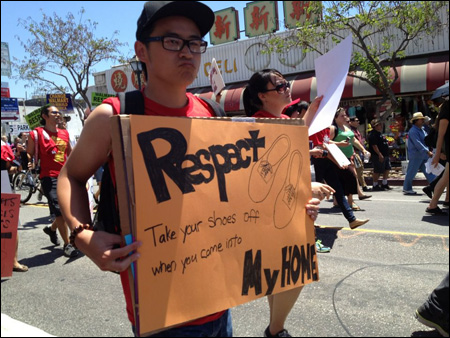
Here, the issue of intersectionality... And also about the 'reclamation' (or simple 'claiming') and radical valuation of positions historically constructed as Asian/"Asiatic," particularly by those who experience the entitlements and privileges of citizenship.
"RESPECT: Take your shoes off when you come into my home"
Let's see how this one unfolds...
Acknowledging, for now, some of my limitations in this post:
Where women have been constructed as Euro-/White-/American women
and examples of Poco Asian Politik have been male...
No explicitly queer examples ------> >:(
Wanting to expand and rectify in future posts.
Subscribe to:
Posts (Atom)