Pages

Email!

musings...

If you like what you see here, or if you have anything you would like to share do send an email:
psychonauterotica@gmail.com

Sunday, November 13, 2011

A Fine Romance

Katies Pumpkin Pie

A fine romance, with no kisses/A fine romance, my friend this is/We should be like a couple of hot tomatoes/But you're as cold as yesterday's mashed potatoes

Recently I've found myself drawn more to the non-sexual aspects of romantic relationships, to the idea of physical, emotional and intellectual closeness, but not necessarily sexual closeness.

If sex is a hot tomato (juicy, somewhat dangerous, a summer fruit), and indifference is a cold potato (unpalatable, starchy, filling, all year long), what I'm looking for is pumpkin pie (sweet, warm, a decadent celebration at a time of year when the temperate Northern hemisphere starts to get dark and cold).

Friday, November 4, 2011

"Fuck" and So What?

Robert Augustus Masters writes a fabulous, simple-yet-sophisticated essay titled “Eros Undressed: An Intimate Look at Sex,” in which he explores the multitudes of diverse roles that sex plays in people’s lives. In this essay, he teases out some assumptions and value systems that may underlie our unconscious relationships to sex.

Masters writes:
"...there is so much that we expect sex to do for us! More often than we might like to admit, we assign it to stress release, security enhancement, spousal pacification, egoic gratification, pleasure production, and other such tasks. We may use it as a super sleeping pill, a rapid-action pick-me-up, an agent of consolation, a haven or hideout, a control tactic, a proof that we’re not that old or cold. We may also employ it as a psychological garbage disposal, a handy somatic terminal for discharging the energies of various unwanted states, like loneliness or rage or desperation. Mostly, though, we just tend to want sex to make us feel better, and we use it accordingly, whether in mundane, dark, or spiritual contexts."

Interesting... but what of it? One segment of his essay struck me in particular, which was his analysis of the use of the word “fuck.”


“Fuck”

I am considering my use of this word.

Masters writes:
“Many of the words and phrases denoting human coitus bluntly illustrate our often confused, disrespectful, and exploitive attitude toward our sexuality, and sexuality in general. Consider, for example, the notorious and enormously popular multivalent “f” word, for which there are an incredible number of non-copulatory meanings, a fucking incredible number, all pointedly and colorfully describing what we may actually be up to when we’re busy being sexual or erotically engaged.

Here is a partial list, most of which overlap in meaning with each other: ignorance (“Fucked if I know”); indifference (“I don’t give a fuck”); degradation (“You stupid fuck”); disappointment (“This is really fucked”); rejection (“Get the fuck out of here!”); manipulation (“You’re fucking with my head”); disgust (“Go fuck yourself”); vexation (“What the fuck are you doing?”); exaggeration (“It was so fucking good!”); situational MSG’ing (“What a fucking great meal!”); rage (“Fuck you!” or “Don’t fuck with me!”); and, perhaps most pithily revealing of all, exploitation (“I got fucked”). It is also worth noting that the noun “fucker” is, though usually far from complimentary, sometimes used in an affectionate or playful manner. A fine fucking mess.”


I am interested in how the uses of the word “fuck,” in all of their myriad, overlapping and confused ways, may indicate how this word has, over time, and through many incarnations and acculturations, come to accommodate the many manifestations of "libidinal" motivations. We may, in the context of a conversation on sex/sexuality, call these manisfestations some translation of "libidinal energy," or in the context of considering the more amorphous, "pure potential" versions of this energy we may call it "life force," or “prana,” or “mana,” or “qi”, or “Lüng” or "Élan vital"

…

Now, I am certainly no expert on any of the aforementioned words and concepts, given their cultural contingencies, and often orthopraxic origins. I have simply cross-clicked on wikipedia to find (somewhat) analogous concepts that can illustrate or hint at some underlying stream of energy/consciousness that stirs our flippancy with (sexualised) terminology. While I have only had a rudimentary experience in considering even just a few of them, they all seem to point to some inherent energetic potential that infuses our selfhood with life, the animalis (having of breath) of our animality.

Different schools of esoteric knowledge have taught various ways of (re-)organising these subtle energies, which I loosely categorise as different therapies, such as acupuncture, reflexology, massage, etc., or as meditative methodologies: From physical yogic postures, to attentional/concentrative practices, to breathwork and breath control, etc.

So these energies, which may otherwise have been channeled into cultivation of qualities such as equanimity, compassion, humility, growth, creativity, and so on, are basically denied ANY existence by the normative epistemological system of Western civilisation, which is empirical science. The empirical sciences (or the ‘hard sciences’) have thus far failed to recognise the objective reality of any existent ‘force’ that we could call Qi, or Lüng, or Prana, etc., and has thus categorically denied its/their (potential) reality entirely.

All of these energies, to the extent that they can be experienced as subjectively "true," are likely to be at the very least systemic combinations of any number of objectifiable entities (e.g. mixes of neurotransmitters, the contact between external conditions with subjectively reported interior "effects," neuro-limbic processes, etc. etc.). This possibility could at least allow for advances in, for example, neuroscience and systems thinking, to make room for (more) scientific anaylses of otherwise amorphous sets of culturally diverse esotericisms.

What I am hypothesising is that, outside of a formal system of organising these energies in the “West,” we have come to inherit …: “Fuck.”

To reiterate from Masters' list, without systemisation, these energies come out in their various guises, articulated by “fuck,” as:
“ignorance (“Fucked if I know”);
indifference (“I don’t give a fuck”);
degradation (“You stupid fuck”);
disappointment (“This is really fucked”);
rejection (“Get the fuck out of here!”);
manipulation (“You’re fucking with my head”);
disgust (“Go fuck yourself”);
vexation (“What the fuck are you doing?”);
exaggeration (“It was so fucking good!”);
situational MSG’ing (“What a fucking great meal!”);
rage (“Fuck you!” or “Don’t fuck with me!”);
and, perhaps most pithily revealing of all, exploitation (“I got fucked”).
It is also worth noting that the noun “fucker” is, though usually far from complimentary, sometimes used in an affectionate or playful manner…”

I would like to add to this list:
intoxication (“we got TOTALLY fucked on booze”);
destruction (“fuck shit up”);
shock/surprise (“fuck! I totally didn’t see you standing there!”)
relief (“fuuuuuuuuuuck….”);

And, finally, and perhaps in a melancholy, poignant, ‘obvious’ sort of way, to refer to typically phallic-/penetrative sex. (“I love to fuck,” “please fuck me,” “do you prefer to fuck or get fucked?”).

As Masters concludes his list, this is “a fine fucking mess.”


So What To Do?

It may be helpful to notice the ways that we use the word “fuck” in everyday language (if we do). We could consider, expediently, fasting from using the word, while bringing mindful attention to the parts of our day when we otherwise typically mindlessly use the word “fuck,” to notice not only how we use this word (which is an interesting enough project on its own, of course), but also how it feels in our bodies when we speak it or resist speaking it, and how these embodied feelings may well overlap, in their confused forms, with our experience of our sexuality.

In the meantime, we may well better tease out new ways of engaging with our energy, so that our propensity to ignorance, indifference, degradation, disappointment, rejection, manipulation, disgust, vexation, exaggeration, situational MSG’ing, rage, exploitation, affection, complimenting, intoxication, destruction, shock, surprise, relief, and sex are properly differentiated from one another, and we may have a better chance at being more involved as agents of our own integration.

I was going to end with a “fuck” pun, but I think I’ll try and practice what I’m preaching, and see what comes of it.

Monday, October 31, 2011

Online Trolls, and Foolish Dissidents

I have participated in a number of different online forums, on a variety of different topics. Mostly, they have to do with politics, culture, and sexuality.

As is the case in the medium of online forums, protected by anonymity and faceless avatars, there are ways that forum participants feels enabled to activate their "troll" selves.

Trolls

According to the Indiana University Information Technology Services (which I was linked to from the wikipedia article about trolls), trolls and the culture of internet trolling are described as follows:

"In email discussion lists, online forums, and Usenet newsgroups, a troll is not a grumpy monster that lives beneath a bridge accosting passers-by, but rather a provocative posting intended to produce a large volume of frivolous responses. The term can also refer to someone making such a posting ("a troll") or to the action ("trolling", "to troll").

The content of a troll posting generally falls into one of several categories. It may consist of an apparently foolish contradiction of common knowledge, a deliberately offensive insult to the readers of a newsgroup or mailing list, or a broad request for trivial follow-up postings. The result of such postings is frequently a flood of angry responses. In some cases, the follow-up messages posted in response to a troll can constitute a large fraction of the contents of a newsgroup or mailing list for as long as several weeks. These messages are transmitted around the world to thousands of computers, wasting network resources and costing money for people who pay to download email or receive Usenet news. Troll threads also frustrate people who are trying to carry on substantive discussions."


While I am easily infuriated by trolling, most trolls who write on online forums are simply impulsive bullies or self-conscious irritants... The best way to deal with them is to Ignore Them.

But there is a more sinister sort of Troll... and I call these trolls the Foolish Dissidents...


Foolish Dissidents


an example from communitychannel (Natalie) on Youtube, responding to a racist message on her forum with a vulnerable and honest acknowledgement of her irritation, in good humour

By "Foolish Dissidents," I mean that these specific sorts of trolls are usually individuals or a set of individuals who seem to genuinely believe that they are engaging in substantive discussions, making worthwhile contributions to an ongoing debate about this or that topic. I call them such, because they are often contrary, and typically blind to their own logical or dialectical shortcomings, or else, just as typically, blind to how their views (and/or the ways that their views are articulated) are irresponsible abuses of privilege.

It is here that I bump into a sort of existential conundrum... How Do I Deal WIth These Foolish Dissidents?

On the one hand, I follow the calling of the Buddhist teaching: That all beings are suffering, and that the proper response to others' sufferings is to cultivate wisdom and apply wisdom in compassionate service.

And this call truly does extend to include ALL Beings, including the Trolls themselves. Trolls, assuming they are not Bots, are just as human as anyone else... but I designate them as simply more suffused with a certain brand of ignorance. What are the rightful expedient means to dispel their ignorance, thus liberating them from their suffering?

But then I bump up into that next part of the conundrum:
Who am I to Educate them? Who are they and who am I in the larger scheme of things? Online forums are but blips in the entire corpus of human history's addiction to Conversation and Dialogue, Dissidence and Demagoguery...

By all this I mean that I come up against the need to monitor MY own trollish-ness... MY own exaggerated claims to moral superiority or secret knowledge. My own hubris, my own propensity to abuse privilege... in short: My own suffering.

What is the 'correct' response then?

Of course it varies from circumstance to circumstance, forum to forum, troll to troll, topic to topic. There are sometimes even gems of wisdom that peek out underneath the smatterings of rhetorical waste that some Foolish Dissidents spew. I can begin by looking for these gems, to honour what it may be that may have been their intent underlying their garbage. The other aspect is to also make a certain distinction, what illdoc1 calls the "What they Said/Did" conversation and the "What they Are" conversation (which he talks about in the context of challenging racist speech).

As he puts it, "those are two totally different conversations, and you need to make sure that you pick the right one." And of course, he is advocating that, in most circumstances, the right conversation to have is the conversation about What They Said/Did, without necessarily extrapolating FROM that around WHO THEY ARE. This, after all, would be allowing myself to become that Foolish Dissident myself.

These conversations are not easy; they rarely are.
But with some skill, an adroit use of humour / developmentally appropriate language to engage all in the forum (not least of whom the troll(s) him/her/themselves), a healthy moderation of my own ego's propensity to over-exaggerate the worth of my own voice in the context of a heated conversation, and ultimately, of course, compassion and forgiveness for all involved (including myself for those times that I have failed to live up to my heightened expectations of spiritual servitude)...

...perhaps I can catalyse at least THIS beginning dialogue into how to be a responsible citizen of cyberspace.

Break? Fast!

I've been taking a break from writing on Psychonaut Erotica.

Part of this is related to my practice of humility: I am aware that, as one of the co-founders of this blog, I unwittingly play or am ascribed the role of moderator, mediator of its content. This is not exactly the easiest role to play, given that the four of us who write here live in disparate locations and do not necessarily know one another in person very well (or perhaps even at all!). So that leaves me as the 'unifying factor' that holds each of us together in a shared vision (I happen to know everyone on here).

Another issue is the ever-shifting landscape of my own intellectual, political, and social needs. I've been re-exploring the tool of facebook, and it is on there that I have been collaborating and sharing ideas around spirituality, integral theory, psycho-spiritual growth, sexuality, politics, and current events.

And lastly, there is the issue of plain old Busy-ness... Negotiating many different relationships at once, both local and international, is in itself a full-time job... which then leaves me without the requisite spaciousness to properly construct the essays of a quality that I unwittingly continue to hold myself up to.

I promise nothing:
I may not write again for awhile, or I may contribute 5 pieces tomorrow.
What I do know with sufficient certainty is that there is something in me brewing... and when the time is ripe for it to be shared, it most certainly will. But I suppose this is as true now as it has ever been.

And so again I return to silence.

Wednesday, October 5, 2011

Education!

Let me tell you what it feels like to stand in front of a white man and explain privilege to him. It hurts. It makes you tired. Sometimes it makes you want to cry. Sometimes it is exhilarating. Every single time it is hard. Every single time I get angry that I have to do this, that this is my job, that this shouldn’t be my job. Every single time I am proud of myself that I’ve been able to say these things because I used to not be able to and because some days I just don’t want to.


Manissa McCleave Maharawal, over on Racialicious

http://www.racialicious.com/2011/10/03/so-real-it-hurts-notes-on-occupy-wall-street/

Sunday, October 2, 2011

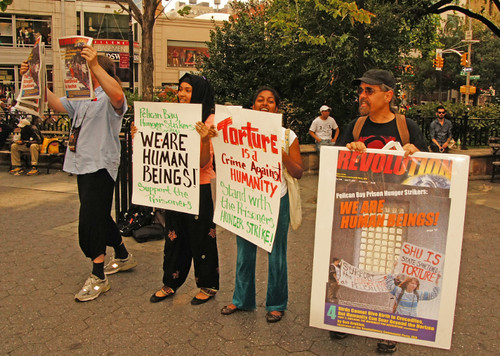
Hunger strike against human rights abuses in California prisons

New York

Like many other prison systems, the California prison system has completely given up on rehabilitation (if that was ever really the goal of such systems in the U.S.), and instead has embarked on a widely acknowledged and well documented campaign against those locked up in its prisons. Its tools include deliberate fomenting of racial strife, gender policing, sanctioned rape and sexual abuse, labor exploitation, systemic humiliation, social deprivation, degradation, and denial of legal due process. One of the most dehumanizing of the prison system's tools (and there are many), is long term isolation, through solitary confinement in facilities euphemistically called "Secure Housing Units" or SHUs in California prisons. The prison system offers, as a thin justification for the use of these techniques, the need to maintain "discipline" and "order."

In the face of the ongoing human rights abuses in California prisons, as of Thursday of last week, almost 12,000 people in prison are participating in a hunger strike. They have only five demands, which, to me, are devastating in their simplicity.

It is an outrage that it takes a hunger strike to have these demands heard. And it is an indicator of how spiritually and morally bankrupt, corrupt, unaccountable and fundamentally broken the prison system (including the private corporations and prison guard unions that are part of that system) has become that CDCR (the California agency that runs prisons) has refused to adequately meet these demands.

There was an initial hunger strike that people locked up in Pelican Bay prison started on July 1, 2011. Thousands of other people who were locked up in other prisons joined that strike in solidarity. Leaders inside called off the strike after almost a month when the CDCR offered to meet some of their demands.

However, it has since become clear that CDCR did not bargain in good faith, and abuses in prison continue, with no clear commitment on the part of CDCR to end them.

People in California, the U.S., and internationally should pay attention to what is happening. Despite a systemic attempt to debase them, people in prison have come together to organize against abuses, and to assert their dignity. They are a shining example of the tenacity of the human spirit in the face of towering odds, and deserve our enthusiastic and grateful support.

A 2009 article in the New Yorker by Atul Gawande examines the use of isolation in prisons:
http://www.newyorker.com/reporting/2009/03/30/090330fa_fact_gawande

For updates on the strikes:
http://prisonerhungerstrikesolidarity.wordpress.com

Some history about Pelican Bay
http://prisonerhungerstrikesolidarity.wordpress.com/pelican-bay/305-2/

Saturday, October 1, 2011

WOW

uni acronym (feat. anne-james chaton) by alva noto

Thursday, September 29, 2011

??? !!!

We can look at the history of the development of many different disciplines of intellectual engagement and theorization. We may see how much these developments are simultaneously meanderings and innovations of, as well as increasingly sophisticated ways that Consciousness gets to know itself.

Just as alchemy preceded but paved the way for chemistry, astrology preceded but paved the way for astronomy, early Vedantic religion preceded but paved the way for Buddhism, feminism for queer theory, and so on and so forth… Just so it is that all of these practical-, belief-, and theoretical- systems themselves become precedents for future elaborations… These are ever more holistic ways of or attempts at describing and measuring our universe and the marvelousness of all of Creation, revelry in the multiplicity of meaning-making systems, but at the same time with seemingly progressive surgical precision.

How does consciousness do this in this way that this is done? Why?

Even questions like “How” and “Why” fly as tepid mistakes in the mysterious, unanswerable and unquestionable mystery that is Consciousness.

Wednesday, September 28, 2011

The Erotic This

This:
The erotic politics of just remaining discernibly present to what presents itself as true and viable and real and possible in each moment that arises... Right before it falls away, back into that primordial void from which it came, and some familiar something emerges in its place (that is, every successive moment, moment and another moment and yet another still…)

This:
This is the beginning of something erotic, my fingers tap tap typing on a keyboard with an agenda: To explore the erotic with abandon, like clothes flung off of a body too weighted by civilisation’s distinctions of top halves and bottom halves, sleeves and sandals, broaches and belts. All the ways our bodies are subdivided become moot when these articles of consensual bondage are tentatively undone. We embrace one another to start toying with uncivilised meaning. Up becomes down, face to crotch, the impropriety of tongue to cock, fingers to cunt, arse to mouth, the eyes that gaze much longer on any given mound of flesh, or that remain shut so that the sounds we typically mold into words escape unformed from some wellspring of vibrations much deeper than our throats… somewhere guttural, gluttonous, gargantuan graceland of moans and yelps and squeals and sighs and we are mammals once again, Thank You Thank You Thank You Thank You for this Marvellous regression.

This:
That this is no regression… No… A prior vision has already structured and enabled this encounter in this incarnation (in words, electronic format, birthed from my fantasy): That we have already conditioned our environs with candles and fresh sheets and calm music (or heavy metal) and latex condoms and lube and drawn curtains and duly forewarned housemates and phones put on silent. This is the earth from which we have planted the seeds of two or more lovers whose time have come to sprout their shoots, dip deep their roots, and bear fruit in carnal convalescence. Lovemaking is the limbic pushed through and emerging, just as whole, but now wings to soar through the frontal cortices of our visionary ill-logic…

This:
The time after with which to reflect with one another on what has just occurred, through giggles and laughter and joy or in sobs or cries or sorrow, or perhaps just a blissful silence through touch... Or in dreams through slumber... (dreams of a dream that has just played itself out). This is the rapturous After, the Real tomorrow. We are grateful that we are alive to witness the gracious gift that we have been bestowed, the gift of this celebration of our bodies in song… Our only mission, should we accept it, is to ensure that the bed gets made, and honour that we remember one another’s names…

Efficiency! Now!

Great post by Adam Frank, "Beyond The Punch-Clock Life: The Tyranny Of Modern Time II" about our conception of time, and why we should change it.

The value of efficiency we learned as children drives the expectation that we can "time-manage" our way out of impossibly overbooked schedules. The myth of multitasking has only compounded this dilemma, taking efficiency to new imaginary limits where we can somehow duplicate ourselves and get twice as much done.

The truth is that we have limits.

Monday, September 26, 2011

Weltschmerz and Compassion

Both forgiveness and compassion arise spontaneously with the opening of the heart. Somehow, in feeling our own pain and sorrow, our own ocean of tears, we come to know that ours is a shared pain and that the mystery and beauty and pain of life cannot be separated. This universal pain, too, is part of our connection with one another, and in the face of it we cannot withhold our love any longer.

Jack Kornfield, A Path With Heart, p 47.

Sunday, September 25, 2011

Integral Theory & Pornography

In my previous post on Abstinence from Porn, I attempted to delineate a 'middle way' between two philosophical extremes, between being 'Anti-Porn' and 'Pro-porn.'

I wrote about abstinence from porn as an opportunity to gain mindful perspective on the nature of sexual desire. And how it manifests itself differently in simulacral form (online internet porn) as compared to the textures of interpersonal, tactile Relationship (being sexual/sensual with others, embodied, and in person).

In this post, I am going to try and speak more about porn from an integral perspective.


AQAL and Porn


According to Ken Wilber's AQAL model, all given phenomena can be apprehended from at least four different perspectives from four 'quadrants,' as shown in the image above.

The top row is about the Individual
The bottom row is about the Collective
The left hand side refers to Interiors
and the right hand side refers to Exteriors

To put them into quadrants, we thus have:
an Upper Left (UL) "Individual Interior"
an Upper Right (UR) "Individual Exterior"
a Lower Left (LL) "Collective Interior"
and a Lower Right (LR) "Collective Exterior"

Let's use porn as an example.

Porn would have a UL, Individual Interior manifestation, these comprise our interior, subjective responses:
e.g. the experience of titilation, yearning, horniness, intentionality, freedom, or disgust, aversion, apathy, boredom, compulsion, guilt, etc.

It manifests in the UR, Individual Exterior, as in its measureable effects on our individual, objectifiable physical body and behavioural change: e.g. bloodflow to genital region, neurotransmissions in our limbic brain, increased heart rate, etc., as well as masturbation, etc.

Porn has LL, Collective Interior or CULTURAL aspects... The "who and what" that is represented, as conditioned by certain cultural expectations of propriety and impropriety, the specific 'fetishisms' that arise, the meaning of certain bodytypes, acts, humiliations, triumphs, cultural tropes that are explored or undermined in the narratives of pornography given diverse cultural contexts etc... For example, Japanese porn and German porn are different not just because of different body/phenotypes, but also because of how these physical types are racialised by consumers both within and outside of their cultural boundaries, for both intended and unintended consumers...

Its LR, Collective Exterior aspects have to do with the measureable, material conditions and its effects on collectives/populations
e.g. How porn is produced and distributed? What is the medium of its expression (print? online video?)? What are the physical sites of its consumption (e.g. in a bedroom? in a cinema?)? What are the political systems are in place that condition its production, distribution, and consumption, and what are the aggregated effects it has on people on a population-wide level (e.g. epidemiological data of correlations between porn use and certain sexual health outcomes), etc...

Any given phenomenon (in this case, porn), exists in the way that it does in ALL FOUR QUADRANTS (there is no phenomenon that ABSENTS its manifestation in any single quadrant).

The study of porn, from an integral perspective, therefore requires the careful consideration of the methodologies for studying the contents of each quadrant.


Considering my Previous post on Abstinence from Porn

In my previous post, I explored the UL by studying the subjective states that arose in me from my consumption of or abstinence from porn throughout the narrative of my personal experiences. I also included the study of some subjective reports from others who had themselves used porn, or who had explored their sexuality with partners who had used porn.

The UR perspective I gave through an amateur elucidation of the material workings of the mind-body in its exposure to pornographic material. Here, I have found Marnia Robinson's blog, Cupid's Poisoned Arrow especially helpful. She talks about the neurochemical differences between pornographic sexual stimulation and interpersonal touch, and how habituation to porn can be argued on the basis of noting brain changes through habitual porn use.

I then briefly mentioned Robinson's failings. She does not adequately address her own biases from a LL and LR perspective. My criticism is of her heteronormative assumptions, and her privileging of monogamy as the ideal social arrangement, through biological determinism: that is to say, through a REDUCTION of the phenomenon of porn/sexual stimulation to its measureable UR manifestations in the brain.

In my last post, I noted how critiques of porn centre around the depiction of women and people of colour (which is a LL analysis using cultural theories: feminist/queer/anti-racist/postcolonial theories), as well as around who owns the means of production (which is both a LL socio- and LR economic analysis). I also surmised that there are liberatory uses of porn in this way as well, in terms of reclaiming porn through a radical emancipatory lens.

My own attempt in finding a 'middle way' here was around integrating the wisdom and perspectives of the LL (feminist, queer) and LR (materialist/Marxist) with those of the UL (phenomenology, personal experience) and UR (neuroscientific understandings)...


And then what?

By integrating these various perspectives in my project to apprehend Porn-As-Phenomenon, I believe I have grown in my own understanding of pornography. I see the limitations of the strictly UL perspective (i.e. ONLY personal experience of porn, which doesn't situate personal experience in a framework of socio-cultural-biological relations), the limitations of Robinson's UR commentaries (which rely on unsophisticated LL assumptions around the primacy of monogamy, heterosexual male experience, etc.) and the limitations of the LL 'culture war' debates.

Neither pro-porn nor anti-porn advocates adequately address the more morally-neutral neurochemical implications of habituation. According to Robinson's commentary, pro-porn proponents do not adequately consider the addictive and escalating potential of porn use, even if it begins innocuously... And of course, anti-porn advocates who shame others into quitting porn for moral reasons themselves inadvertently HEIGHTEN the addictive quality of porn (because that which is forbidden elicits a greater 'hit' of dopamine rush, which is implicated in experiences of addiction).

In other words, while Robinson's UR reductionism could use some LL deconstruction, the LL perspectives that I delineated as strawmen in my last article could also use the wisdom of the UR (made possible because of advances in neuroscience) and the LR (made possible because of emerging epidemiological/social research data, for example, on the correlation of endemic porn use with erectile (dys)function).


That said, I would like to address some of my own assumptions in my critique of porn use, and in my personal decision to opt for abstinence... and I will raise some further questions for pondering.

1. That Authenticity is important in sexual experience
and that porn is 'less authentic' than relating to another person in person. What IS authenticity? What are measures of authenticity? To be informed by neurochemical affect (UL & UR) is one thing, but to assume that 'authenticity,' however it is arbitrarily defined, is impossible through porn... That was a bit of a philosophical leap. I also did not consider the specific sorts of intimacies that could hypothetically be enabled by using porn with a partner.

2. That the Interpersonal is more central to sexuality than Solo sexuality
What role does the Other play in my experience of authentic sexual experience? Are there hierarchies of contact with the Other? Who draws these lines where? Why do I privilege certain sorts of contact with Others as compared to another (sort of contact)?

There are all sorts of sexual relationships one can have with others...
There could be an Orgy / Group Sex encounter
A one-on-one sexual encounter with One other
The contact with the Other through porn (which involved real people in its production)
The contact with the Other through fantasy while masturbating solo
The complete non-contact with the Other through masturbating solo and intentionally focusing on one's own body.

Perhaps Porn is LITERALLY a middle-way between certain extremes?

Still, I would argue that mindful masturbation (remaining present with the sensations of my own body) is more emancipatory, from a strictly meditative component, as compared EITHER to mindless pornographic consumption OR mindless sex with others. This likely will require a future post for elaboration...

3. That the 'producers' of porn are the empowered, owning classes
I have a slightly different perspective on this now, based on an amazing conversation I had yesterday with a group of folks on this piece on Integral Sexology by Ray Harris... Factoring a more traditional, Marxist, class-critique of porn in a late-capitalist world... We can consider how sexual experience has historically required that all of us identify with Labour. We work to have sex. We court, we date, we buy dinner, we flirt, we dance; We have to increase our skills in these ways in order to reach orgasmic satisfaction in interaction with Others.

However, now, the ubiquity of porn means that consumers of porn no longer require the Marxist revolution, i.e. identifying with Labour and empowering ourselves by taking control of the means of production, such as the people depicted in porn simultaneously owning the cameras, and the channels of distribution if any at all...

Instead, we now identify with the owning classes: That we are ENTITLED to others' sexual Labour, that we need only click a mouse or a button with high speed internet access in order to be titillated... We require no introspection, no wresting of control of the 'means of production,' etc. etc.

Far from being the Enemy, producers of porn are simply pawns... They are rewarded by consumers, who pit the Labour of the producers AGAINST the Labour of the actors...

My previous proposed solution was from the perspective of the 'owning class' of the Consumer of porn. That is: To abstain from consumption altogether.

But another potential solution (or attempt at redress) can be in the form of identifying with sexual Labour, and to then work more closely with Producers and Actors of porn, indeed, perhaps even dissolving that distinction altogether. To be producer, actor, AND consumer of porn that I co-create with a community of folks who are similarly committed to emancipation and de-habituation (from compulsive patterns of consumption) as well as to Love.

Indeed, while this may look nothing like porn as we know it, it would be helpful not to toss porn out of the window... Far more dangerous and liberating to completely demystify it, and feel THAT freedom. The only way out as Through...

Saturday, September 17, 2011

Pro basketball player changes name to Metta World Peace

Basketball

"Changing my name was meant to inspire and bring youth together all around the world," World Peace said in a statement released after the hearing [to change his name].

Link to AP article: Artest's name change to Metta World Peace approved

Friday, September 16, 2011

Podcasts

Radio

Here's what I'm listening to these days:

On Being
Krista Tippett interviews various people about being. Previously "Speaking of Faith." Sometimes a little too middle-of-the-road for me, but I do appreciate the interfaith nature of it.

Counterspin
Fairness and Accuracy in Reporting (FAIR)'s podcast. A cutting, often snarky take on the week's mainstream media junk reporting. Also features one or two substantive interviews on important issues that the mainstream news misreports or fails to report on.

Friday Night Comedy from BBC Radio 4
Kind of a mixed bag. They showcase different programs each week. My favorite is The News Quiz, featuring dryly hilarious Danish lesbian host Sandy Toksvig. The past month, however, has been this awfully dull interview show, Chain Reaction.

Get-Fit Guy's Quick and Dirty Tips to Slim Down and Shape Up
What can I say, I'm still questing after the body perfectible. One day I will take seriously in my own life Judith Butler's question, "what can a body do?"

On The Media
Another snarky media analysis program. Less progressive than Counterspin, but often funnier. I think they also have a bigger budget, so can do longer features on special subjects, and sometimes do theme shows on trends in the media. They also have a broader conception of "media," including reporting on social media and not-strictly-news internet media, like blogs.

The Moth Podcast
Live storytelling show. Generally high caliber stories, but of course they have different people each time. I've heard some pretty moving and funny stuff, but once in a while there's some sentimental pablum.

Wait Wait Don't Tell Me
Comedy News show based in Chicago, with a rotating panel of guest journalists and comedians. My favorite regular personalities are Paula Poundstone and Mo Rocca. One time they had Maz Jobrani (who did the Axis of Evil comedy tour) on, which was great.

Latino USA
News magazine program on issues of relevance to Latinos. I really appreciate their coverage of immigration issues, though sometimes I get too emotional and I have to stop listening.

Snap Judgment
Another storytelling podcast, hosted by Glynn Washington, based in Oakland. I really like the show, but sometimes I find Glynn's hosting personality gets in the way. He does it in this conspiratorial whisper that is a bit over the top. Great featuring of stories from people of color and Bay Area folks.

Philosophy Bites
A connection to my undergrad. I love geeking out on discussions of consequentialism, especially.

Selected Shorts
I don't listen to this all that often, but it's good for airplane rides, when I have a long hour without interruption or other distractions. Famous and famous-ish people (usually actors or authors) reading great short stories, often (or always?) to a live audience, which adds something special.

To The Best of Our Knowledge
Magazine program featuring authors and other thinkers on a variety of subjects. Each week they have a theme. One recurring subject is the intersection of science and faith, I think because one of their big sponsors is the Templeton foundation. Pretty middle of the road, politically, which means in America it's kind of left-y.

RISK!
Another storytelling podcast - more sexual and dirty than either the Moth or Snap Judgment. They get some big names on sometimes, I think maybe because host Kevin Allison was pretty famous as a comedian, and gets comedian pals to come on sometimes. His hosting does get in the way, and he usually tells a story or two. I like that he is super openly gay and talks about that in his stories. I do NOT like when he talks about his Asian guy fetish - I think it's pretty much straight up racist and alienating. Still, some good LGB representation in the storytellers, which I appreciate.

The Sporkful
This is a new one for me. An irreverent take on food. So far I'm enjoying it, mainly because the hosts don't feel the need to gush about food they enjoy. How many ways, seriously, can a radio host find to say "this tastes good"?

Studio 360
Arts magazine show. The host, Kurt Anderson, is spiky, quirky and amusing. I like his interview style. They feature some good musicians, too. Pretty accessible and fun take on the art world. Shows generally do not have a theme, but have a feature story. They did a great series of shows on American Icons, where each show had a certain theme. My favorite was the entire show on "I Love Lucy."

Stuff You Should Know
Ridiculously addictive random science (and other trivia) podcast, featuring co-hosts Chuck and Josh, with Josh being the kidder and Chuck sort of playing the straight man (though he sometimes does voices, which amuses Josh to no end). Really what I enjoy about the show is their dynamic - it's two male best friends just hanging out. It kind of reminds me of hanging out with my college roommate Evan. If one gets a voyeuristic thrill from witnessing friendship, this show is the one to listen to. Also, I have a crush on Josh's voice.

This American Life
Ira Glass is sort of the Lady Gaga of the NPR aging hipster set. Apparently I am in this set, because for me, this show reaches heights of magnificence other radio shows can only dream of. They broadcast every Sunday, and the podcast comes out soon after. I listen religiously. Many of their episodes have made me cry. I used to listen to this show on my bike ride to my therapist, and I realized I would then just spend half my session talking about the show and how it made me feel.

A Way With Words
A show about language, mainly English. The hosts are lovely, though kind of corny. They have a regular segment with a Quiz guy or "Quizzicist," when they play word games, which is quite enjoyable. I do love finding out trivia about this weird thing we call the English language.

Radiolab
Kind of a nerdier, science-ier This American Life. I wish they had longer seasons - they seem to only do a handful of shows per season, on a certain theme. The co-hosts, Jad and Robert, have a great dynamic going on. They also do some really great things with music and voice, transmuting one into the other in virtuosic feats of technoradio wizardry.

Tuesday, September 13, 2011

On Potential

“Our deepest fear is not that we are inadequate. Our deepest fear is that we are powerful beyond measure. It is our light, not our darkness that most frightens us. We ask ourselves, Who am I to be brilliant, gorgeous, talented, fabulous? Actually, who are you not to be? You are a child of God. Your playing small does not serve the world. There is nothing enlightened about shrinking so that other people won't feel insecure around you. We are all meant to shine, as children do. We were born to make manifest the glory of God that is within us. It's not just in some of us; it's in everyone. And as we let our own light shine, we unconsciously give other people permission to do the same. As we are liberated from our own fear, our presence automatically liberates others.”
- Marianne Williamson

Thursday, September 8, 2011

On Trusting Yourself

"What lies behind us, and what lies before us, are tiny matters compared to what lies within us."
~Ralph Waldo Emerson

Tuesday, September 6, 2011

Fighting Back, and Compromise


"In Hell (with Jean-Claude van Damme), a bleak story set in a corrupt post-Soviet Russian prison, contains a surprisingly accurate Christological moment. Van Damme plays an American working in Moscow who, sentenced to prison long-term for killing the murderer of his wife, has to fight brutal to-the-death duels with other prisoners to satisfy the guard who put high bets on the fights. Unable to finish off his beaten opponent, van Damme refuses to fight and is cruelly punished, chained to a high mast where he hangs for days without food and water, until he will once again agree to fight. One of the prisoners, observing from the cell window, complains to his mates: "Why does he refuse to fight? He will not only lose and die, but also bring trouble to all of us!" A wise colleague replies: "No! Can't you see he is not fighting for all of us!" And he is of course right: van Damme's refusal to fight is in itself a more dangerous fight to change the whole life of the prison, so that prisoners will no longer be forced to stage cruel combats for the obscene amusement of their jailers. This is a paradigmatic case of Jesus' line from Matthew [Matthew 5: 38-40]: "Whoever slaps you on the right cheek, turn the other to him also." Sometimes, a refusal to fight amounts to a much more violent gesture of refusing the entire field that has determined the conditions of the fight; likewise, sometimes, directly striking back is the surest sign of compromise."

- Slavoj Zizek, from "Living in the End Times" pp 126-127

Wednesday, August 31, 2011

The Little Hater

For the times our Little Hater gets in the way of delivering something creative...

Beating the Little Hater


Ballad of the Little Hater


Sunday, August 28, 2011

Growing up Middle Class in Singapore - Part 2

Tie

Work/Merit

I received various messages about the purpose and nature of work when I was growing up. One important idea was that work could, and should, be meaningful. It could be challenging, interesting, and, importantly, make a difference in the world. "When you grow up, you need to make a mark," my father would say to me, as a way of motivating me to study harder, or to try to get into a "top" school.

Which brings me to a second set of messages about work - that personal responsibility mattered, meritocracy prevailed and that this was a good thing. I learned that if somehow you failed to get meaningful work, that it was your own fault for not trying hard enough. This fit well with the idea that the world should (and did) reward merit, and punished mediocrity, and that this system was a good one. Along with that was the idea that merit could be measured relatively objectively, and was separate from "politics," as in office politics, which both my parents, to my recollection, spoke of in disparaging terms.

My parents did acknowledge that some people did not have the same opportunities as others to succeed under the existing system, but the solution was to give them those opportunities while maintaining the meritocracy. In other words, to make the system more meritocratic, and minimize what I think they thought of as accidents of birth. Both my parents had gone to college in the U.S. on scholarships, and my father, especially, was very grateful for having had the opportunity to do so.

As a child raised for most of my life in the middle class, I was told that I had every opportunity, and that, if I failed to take advantage, and to make something of myself, I had nobody but myself to blame if I ended up... someplace bad. It was never said explicitly in our nuclear household - I think both my parents were too liberal to repeat the cliched Singaporean/Malaysian warning that if I didn't work hard, I would end up a roadsweeper - but I think that this unspoken (unspeakable?) fear was of ending up in poverty or working a "mindless" job, or both - to become somebody to pity and/or despise.

I internalized this message strongly. At the age of about nine or ten, a partner at my father's law firm who was visiting from the U.S. asked me what I thought of affirmative action, and explained (inaccurately, and certainly incompletely) that it was a system of giving preference to candidates for colleges based on race. I immediately jumped at the opportunity to trumpet my meritocratic ideals, and emphatically denounced such a system. This drew some delighted laughter from the visitor. I don't know what his intention was in asking such a question of a child, and I don't know what impact my answer had on my parents, both of whom had attended college in the U.S. as Asian people in the 70s and may have themselves benefited from race-based affirmative action, whether they knew it or not. If they objected to my answer, they held their tongues.

I also learned how to wield these ideas as weapons. Once, upset at my father for lecturing me about some bad grade or other, I threw the idea of meaningful work being the reward for industriousness back in his face. "What change in the world does your job accomplish?" I spat, "you're just a lawyer who helps companies make a lot of money!" In essence, I was questioning his credentials - who are you to tell me how to live my life, when you have a job that doesn't measure up?

Both my parents were professionals with prestigious advanced degrees. My mother was a professor of science, having received her higher education in the U.S. and the UK. Most of her career was at the National University of Singapore. My father got his education also in the U.S. and UK, taught in a University for a while, then returned to University in the UK for a law degree, and became a lawyer. He worked for most of his career with a large firm.

I idolized my parents for their intelligence and hard work. In the universe of possible meaningful future careers, academic and lawyer were pretty much at the top of my list. They still are today.

Rarely did my parents talk about how difficult it was to make their way through college as foreign students who had been raised working class and poor. I think that doing so would have threatened both the idea that the world was at least relatively meritocratic, and that there were neutral standards of merit out there. However, there are a few memories that stand out from my childhood as a clue to how hard it was for my parents.

My mother once told me how hard it was for her to leave home. It was strange to her to think of there being a "good" school so far away. She did not know how to decide which schools were good or not. Once she had been accepted to the school of her choice, her mother, my Amah, objected strenuously to her leaving - from her point of view, she was losing her daughter, and for what? My Ah Kong, my mother's father, however, was a teacher, and supported my mother's desire to get a good education. My mother ended up going to that school and now, as an alum, helps to recruit and interview young women in Singapore and Malaysia for her alma mater.

My father would sometimes allude to the racism of white people, specifically certain partners in his law firm (this was before he made partner himself), and professors in the US and UK. "They think they're smarter than me just because they're white," he said. He told me he had to work much harder, and be much smarter, than his white counterparts, just to prove he belonged, and deserved to be there. Even after he made partner, he told me, some white partners in the firm would treat him with condescension and hostility, especially refusing to credit him for his ideas for directions the firm should take.

As I reflect on work now, I want to hold on to the idea that work can be meaningful, but let go of the idea that there is a hierarchy of work, that only certain people (hardworking, smart people) deserve to do meaningful work, and that anyone who works at a job they dislike does so because they didn't try hard enough or weren't smart enough to do anything else. It is very difficult to let go of this idea, however. Not only was I raised with it, but it is constantly reinforced now. It's an easy thing to fall back on too, when my ego is shaken by the daily indignities of living in this society - I may have it bad, but at least I'm smart enough to not be working at that guy's job.

It is important, as a mainly raised middle-class child, that I did still get some glimpses of my parents' insights and experiences from being raised poor and working-class, even if they came with a heady chaser of meritocratic ideology. I think that I would also like to talk with them more about their experiences becoming middle-class, especially to see if they feel like they have lost something in the process. I know that I feel a sense of loss having left Singapore to come to the U.S., in order to go to a "good" school, and then "make it" in a major center of capitalist power.